



fasters
-
Posts
4 -
Joined
-
Last visited
Everything posted by fasters
-
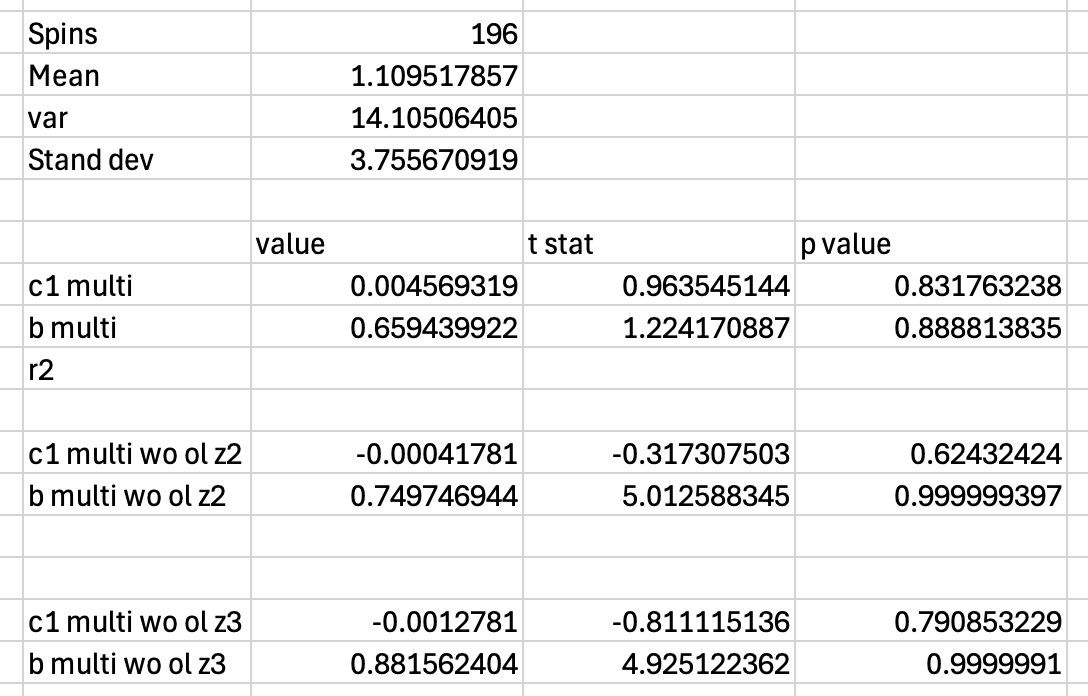
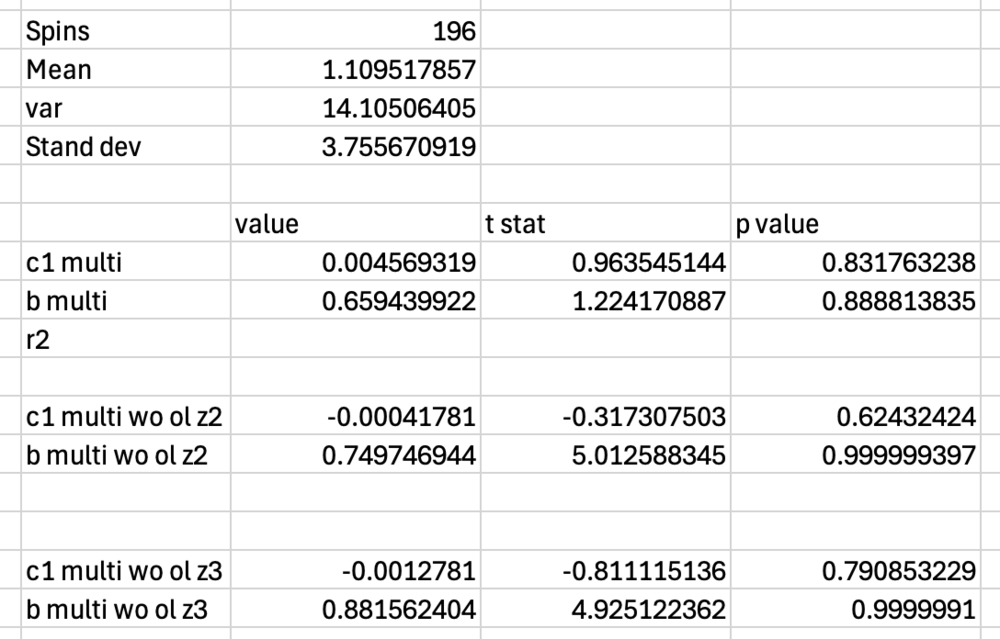
I've checked some random casino stats (criteria: they provides bet stats download; no brand mention, that's why just C). Methodology: the regression analysis of multipliers vs sequence number of spin. Outcomes and explanations are attached below. Data explanation: 196 obs, only buying fs; to avoid the impact of big wins I cleaned the outliers (but every buying fs option gives 10 spins; so it is 1960 spins observed). So, C outcomes Explanation: RTP in regression model is going to the value of 66%...... Slope has a positive value but it can be explain by x65 at the end of session, that's why I decided to check it out without outliers impact. z criteria = 2 (95% of probability that outliers has significant impact) shows us the growth of RTP as well as the negative value of stat significant slope z criteria = 3 (99% of probability that outliers has significant impact) shows us again the growth of RTP up to 88% as well as the higher negative value of stat significant slope (with higher level of stat significance) Disclaimer: there is too small amount of obs. But trend is obviously negative. There should be explained by the size of sample. But you can see the slope is going to be decreased. It is not good. It looks as a possible scam. We need to check it out with more data. @pragmaticplaysgd would say that it is a too small sample. They would be right. But are they going to share with us some details that will convince us it is just a conspiracy?
-
@Andy86 Let me be frank — it sounds like a conspiracy without explanations. Could I ask you to provide some additional facts that confirm your statement? Nothing personal — I believe you are a great person and I'm so grateful that you supported me with your post. The thing here is that the provider possesses an RTP certificate that confirms the randomised outputs. The last test was successfully passed on 31 Dec 2025. This is the reason why we should try to present FACTS when we are making claims against a software provider. As I mentioned above, I have heard a lot of critical opinions, but they could be explained by the really huge RTP deviation (I mean it takes definitely hundreds of millions or even billions of spins to reach the stable mean of the declared RTP) as well as by biased selective memory, which is the natural cognitive reaction of a person who has spent hours buying free spins expecting a huge win but hasn't achieved even 2x of the buy-in amount. The point here is the unbelievable popularity of these slots among experienced gamblers — PP has crafted an iconic slot, I believe. And it is definitely my personal #1 (I would like to ask the Yggdrasil brand representatives for forgiveness here for my shameful betrayal of Vikings Go Berzerk Reloaded; you were great, but PP is now making me go mad). Nevertheless, despite all the points above, I*ve found myself having the mysterious feeling of shifting RTP patterns depending on the session volumes. I started to test it in different casinos and came across the same pattern every time. I asked for the opinions of people involved in the industry and encountered the same concern. BUT AGAIN: I can't make the statement that PP has implemented some RTP shifting BECAUSE I understand that this would be just a crazy action with no sense. I have no ability to verify this hypothesis — that's why I am here asking Pragmatic Play for their position. @pragmaticplaysgd may I ask you to join our discussion?
-
@Afi4wins Sure, every provider or casino has its trade secrets — no one's arguing that they should publish their entire source code or reveal proprietary math models. That's fair. But we're talking about one of the most famous iGaming producers — Pragmatic Play. This isn't some no-name offshore outfit. Their reputation is literally one of their most valuable business assets. And reputation, unlike code, is built on trust. So here's what I don't quite follow: there are passionate players and analysts who genuinely want to verify that Pragmatic's games are fair. That's not an attack — that's a way to prevent trust erosion. And a great opportunity to earn positive PR points for free (because I personally don't think they are cheating). My honest aim is simply collaboration in case the RTP checks out clean. Or, sure — grab tonnes of hype if I happen to find some evidence. So instead of embracing that enthusiasm, would they really choose to ignore it? Why? If everything is above board, independent verification only strengthens their name. The only scenario where more scrutiny is a problem is when there's something that scrutiny might find. So which one is it?
-
Hey everyone, Wanted to bring up something that's been bugging me for a while regarding Zeus vs Hades – Gods of War. Don't get me wrong — the game is absolutely fantastic, one of the best releases from Pragmatic in recent memory. The theme, the mechanics, the buy-in feature — top tier stuff. But there's something I keep hearing from multiple sources that I think deserves a proper public conversation. I've been chatting with quite a few people — both on the player side and some operator reps (can't name names, they asked me not to) — and there's a recurring theme that keeps popping up: the practical RTP spread on this slot feels wild, even by high-vol standards. Like, we all know what variance looks like, we've all had those 500-spin dead zones followed by a 5000x nuke. That's the game. But the pattern people describe goes a bit beyond that. Specifically, what I keep hearing is this: longer sessions at a single casino seem to produce a noticeable decline in the frequency of big multipliers during the bonus round. The first few buy-ins might feel "normal," maybe even generous — but the deeper you go in one sitting at one operator, the colder it gets. And not just "I got unlucky cold" — more like "the slot fundamentally shifted gears cold." Now — I KNOW what this sounds like. Classic gambler's fallacy, confirmation bias, selective memory, the whole nine yards. I'm fully aware. And honestly, that's probably what it is for most people who say this. But here's what made me take notice: it's not just random forum complaints anymore. The sheer volume and consistency of these reports — from experienced players who understand variance, and from operator-side people who see aggregated data — is getting harder to brush off with a simple "that's just how RNG works, bro." There's a growing sentiment out there that short sessions across multiple operators yield better practical returns than one extended session at a single operator. Whether that's a real phenomenon or a massive collective cognitive bias — I genuinely don't know. And that's exactly why I think we need proper, independent research rather than just vibes and anecdotes. So I have questions for three groups: To Pragmatic Play: What is the recommended spin horizon for statistically significant RTP conclusions on Zeus vs Hades? We're talking about a high-volatility title — so the convergence window must be massive. Can you share the declared volatility parameters (variance, hit rate distributions, etc.) that would allow the community or independent researchers to calculate meaningful confidence intervals? And most importantly — can you confirm that the RTP mechanism is session-length agnostic and provide any data or methodology that demonstrates this? To operators: Is anyone willing to collaborate on a controlled test? Even anonymized aggregate data from your backend — comparing RTP across different session lengths for this specific title — would be incredibly valuable. This kind of transparency benefits everyone: players get peace of mind, operators build trust, and providers clear their name if (when?) the hypothesis turns out to be nothing. To the community: Has anyone actually done any structured testing on this? I'm not talking about "I did 200 buy-ins and here's my spreadsheet" — I mean proper methodology: controlled bankroll, fixed bet size, documented session lengths, multiple operators, large sample sizes. If you have data, I'd love to see it. I want to be clear — I'm not pushing a conspiracy theory here. I'm doing the opposite. I think the best way to kill a rumor is with data, not dismissal. And right now, there's a gap where data should be. Curious to hear your thoughts.
- 28 replies
-
- 1
-

-
- pragmatic slots
- pragmatic play demo
- (and 1 more)